Comeau Computing Tech Magazine 2024
Liquidity conditions can change how a Solana token behaves even when its code has not changed. Pool depth, swap fees, route selection, and volatility influence execution and the numbers shown by connected tools. ChartUp gives developers a way to create controlled transaction flow in private environments and observe those systems before deployment. The goal is not to manufacture a public impression, but to expose how a build responds when activity reaches its liquidity venue.
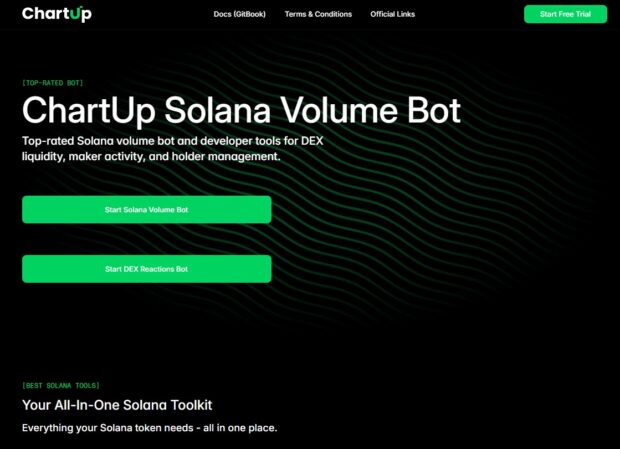
The chartup sol volume bot distributes buys and sells across unique wallets with variable sizes and timing. A developer can select fast Jito execution for a compact routing check or organic execution for a longer, irregular observation. Because the task is automated, the test plan should state the chosen mode, pool, duration, and expected signals in advance. That record makes later analysis much more credible.
DEX Choice Defines the Liquidity Scenario
Venue selection is central to the experiment. ChartUp covers Raydium, Pumpfun, PumpSwap, LaunchLab, Bonkfun, Meteora, Meteora DBC, Jupiter Studio, BelieveApp, Bags, Heaven, Moonit, Moonshot, and other Solana launchpads. Their fee and liquidity models are not identical. An estimate based on Raydium’s 0.25% swap fee will differ from Pumpfun’s 1.25% fee, so cross-platform comparisons need normalization.
Observing and Editing the Active Task
Teams can monitor live statistics and budget as the task proceeds. If the cadence is wrong for the system under review, swap speed can be adjusted; if an error appears, the order can be paused and resumed after correction. The contract address can also be changed, allowing unused allocation to continue with a revised private build. These controls help convert a static package into an iterative liquidity test.

Handling a Pool Migration
Automatic migration support addresses another Solana-specific case. When a token moves from one pool to another, ChartUp can detect the transition and redirect the active task. Developers can then examine whether their own interface, price display, and indexer follow that move. The migration should be timestamped so events from the old and new venues remain distinguishable during review.
For deeper QA, the team can capture pool depth and displayed price immediately before the run, at fixed checkpoints, and after completion. These snapshots do not predict public performance, but they help engineers connect an interface change to the liquidity conditions that existed when the automated event occurred.
Budget and Duration Boundaries
Packages range from 1.5 to 54 SOL, with duration settings from one hour to seven days. A dynamic calculator updates estimates using the SOL price, but no package can guarantee an exact result. Market activity, token volatility, pool state, platform performance, and network conditions remain external variables. A modest trial or short package is usually the better first step for a new venue configuration.
Trial Access and Credential Safety
The free trial supports several widely used pools and does not require payment. ChartUp also states that it never requests private keys, seed phrases, personal information, or a wallet connection; payments are processed securely on-chain. That operational model limits credential exposure, although teams must still verify contract details carefully and apply their own access and review procedures.
Liquidity Simulation Verdict
ChartUp offers a credible set of controls for liquidity-condition simulation when teams use it as an engineering instrument. It is not intended for public launches, investor-facing applications, live projects, or real-user financial activity. Within private development, broad pool support, distributed execution, and migration handling can reveal integration problems while preserving a clear distinction between synthetic test data and authentic Solana participation.